The Twenty-Eight Days Before A Slab Is Sealed
New concrete cannot be sealed straight away, and salt on an uncured slab is the most expensive winter mistake available. The timing is not negotiable.
Why the slab waits
Fresh concrete is still curing long after it is hard enough to drive on. The usual figure in manufacturer guidance is twenty-eight days before a slab should meet a penetrating sealer or a de-icing salt, and full strength development runs longer than that again.
Seal it early and the sealer sits on a surface that is still releasing moisture, which is how you get a cloudy finish, poor adhesion, or a film that lifts within a season. Salt it early and the damage is structural rather than cosmetic.
What salt actually does to it
De-icing salt does not dissolve concrete. It does something less obvious and worse: it lowers the freezing point of water at the surface, which multiplies the number of freeze-thaw cycles the slab goes through in a winter.
Each cycle expands trapped water inside the surface layer. Repeat it enough times and the top few millimetres let go — scaling, pop-outs, then a pitted surface that holds more water and freezes faster. On a young slab that has not reached full strength, the process starts earlier and moves faster.
Salt does not eat concrete. It just arranges for the winter to do it far more times than it otherwise would.
The window here is narrower than the calendar suggests
Sealing needs the slab dry, the air warm enough, and no rain during cure. In this region that rules out most of the year rather than a little of it.
With roughly three quarters of the annual precipitation falling between October and March according to the Environment and Climate Change Canada normals, the practical sealing season runs from late spring to early autumn — and inside it, what is actually needed is a run of consecutive dry days rather than one.
That is why sealing gets booked against a forecast rather than against a date, and why a contractor who moves the date is usually doing the right thing.
What happens before the sealer
Sealing a dirty slab locks the dirt in. The preparation is most of the job and it runs in a fixed order:
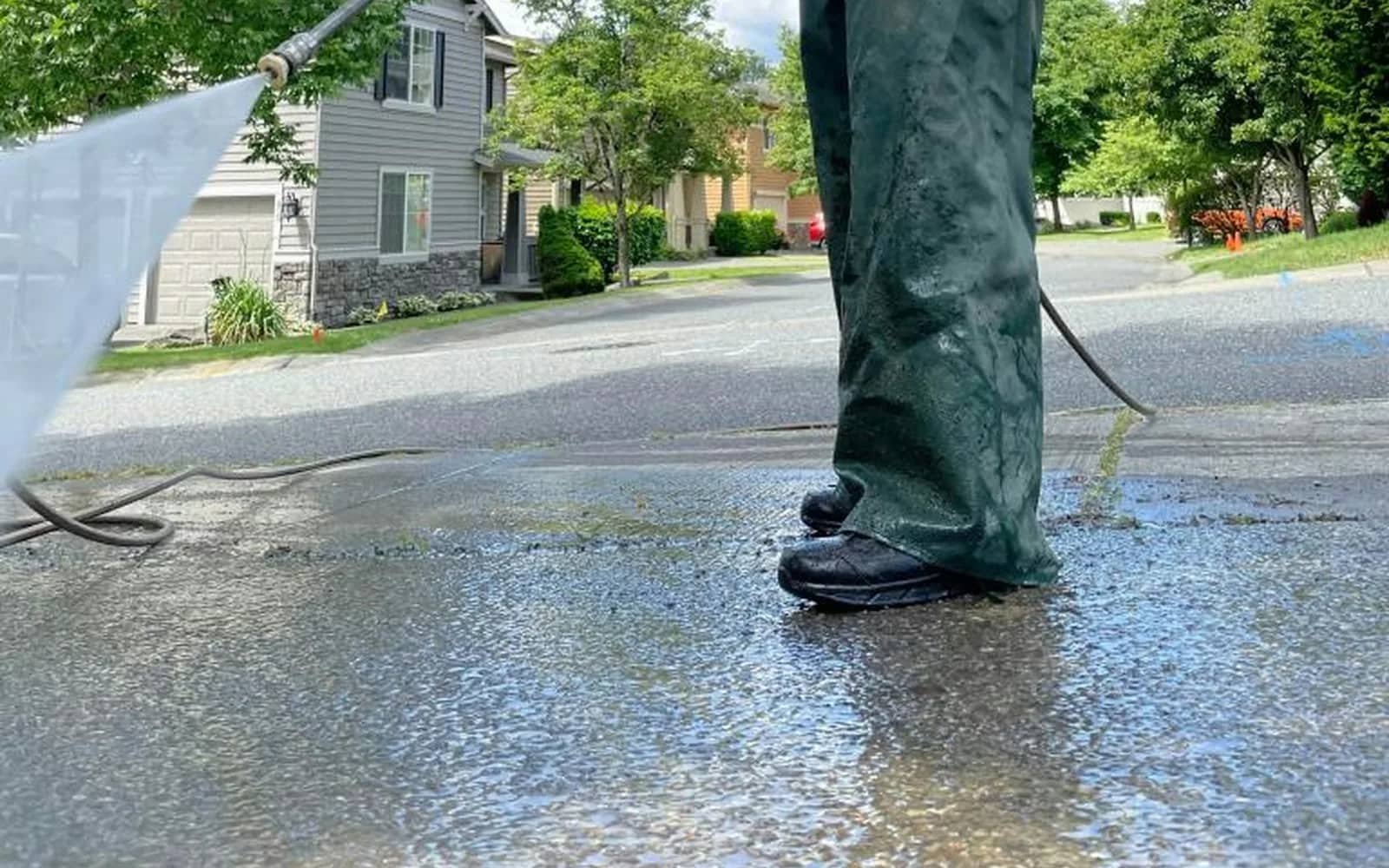
- Clean the surface properly, including the oil. Oil and tyre marks are not dirt and do not come off with water alone; they are degreased separately or the sealer will not bond over them.
- Deal with the cracks. Routed and filled before sealing, because a sealer bridges nothing — a crack under a fresh coat is a crack with a coat over it.
- Let it dry. A washed slab holds water for longer than it looks, and this is where a rushed job goes wrong.
- Confirm the slab is actually dry rather than dry-looking, then seal in two light coats rather than one heavy one, with the second worked across the first.
The order is not stylistic. Every step is there because the one after it fails without it.
Questions About Concrete And Asphalt Sealing in BC
How long after pouring can concrete be sealed?
Manufacturer guidance commonly sets twenty-eight days as the minimum before a penetrating sealer or de-icing salt should touch a new slab, and the product data sheet for whatever is being applied governs. If a contractor offers to seal a slab poured a fortnight ago, that is the wrong answer.
Does sealing actually prevent salt damage?
It substantially reduces it rather than eliminating it, by limiting how much water and dissolved salt gets into the surface in the first place. It is not a substitute for keeping salt use proportionate, particularly on younger concrete.
When is the best time of year to seal in Greater Vancouver?
Late spring through early autumn, and inside that window the deciding factor is a run of dry days rather than the month. Sealing needs the slab dry going on and dry while it cures, which is a scarcer condition here than the calendar implies.
How often does a driveway need resealing?
It depends on the product used, the traffic it carries and how much sun the surface takes. The honest way to answer it is to look at how the last coat is wearing rather than to count years — a surface that has started to darken and absorb water at the edges is telling you where it is.
Can a slab be sealed over moss or oil?
No. Both have to come off first — moss because the sealer will not bond to it, oil because it will not bond over it and the stain is then permanent under a coat. Preparation is most of the job, and skipping it is visible within a year.
Where to read the rest
Crack routing, degreasing, moisture metering and the two-coat application are set out on the concrete and asphalt sealing page. The cleaning that comes first is power washing, and winter salting is on the snow removal page.